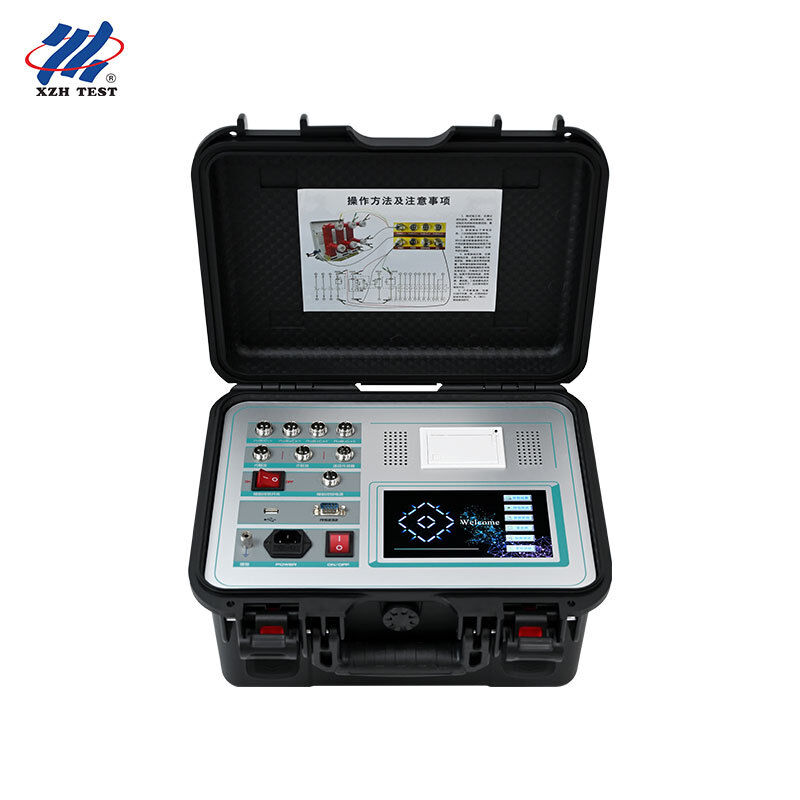
High Voltage Circuit Breaker Analyzer | XHJJ302AC
The XHJJ302AC high-voltage circuit breaker analyzer, also known as the high-voltage switch mechanical characteristic tester, can accurately measure the mechanical dynamic characteristic parameters of high-voltage circuit breakers of various voltage levels, including low-oil, high-oil, vacuum and sulfur hexafluoride (SF6) circuit breakers. The measurement data is stable with strong anti-interference capability, and experiments can be performed in power stations of 500kV and below.
Taking advanced technology as the core to process the test data, the switch mechanical properties tester features high intelligence, abundant functions, accurate test data, strong anti-jamming, easy operation, small size and light weight. It is the most convenient tool for high-voltage switch maintenance and testing.
The instrument is suitable for the measurement of opening time, closing time, synchronization, travel, over-travel, rebound, just-opening speed, just-closing speed, average speed and maximum speed of high-voltage circuit breakers, as well as the automatic low-voltage action test and the breaker aging (life) test. With independent 12 fracture (contact) ports and a 320×240 large-screen LCD, it provides comprehensive data for preventive maintenance, acceptance testing and troubleshooting of circuit breakers in substations, power plants and industrial power systems.
Applications & Target Audience: Designed for high-voltage switchgear and circuit breaker manufacturers performing routine and type tests, professional high-voltage switch maintenance and overhaul service companies, new energy equipment manufacturers testing DC switches of photovoltaic inverters and energy storage converters, electrical departments of textile, food and beverage light industry plants, semiconductor and electronics factories maintaining cleanroom high-voltage power distribution, and power testing equipment rental and test service providers.
Key Specifications
| Parameter | Specification |
|---|
| Model | XHJJ302AC |
| Time Test Range | 0.01 ~ 9000 ms |
| Speed Test Range | 0.01 ~ 25.00 m/s (1 mm sensor) |
| Speed Sensors | 1 mm sensor, 0.1 mm sensor, 0.5° angle sensor |
| Linear Displacement Sensor | 50 mm range, 0.1 mm resolution, stroke 0.1 ~ 50 mm |
| Stroke Measurement | Moving contact stroke (travel) and over-travel |
| Contact (Fracture) Ports | 12 independent ports with connection status detection |
| Energy Storage Motor Output | 25 ~ 265V continuously adjustable, current ≤ 15A (short time) |
| DC Power Output | 25 ~ 265V continuously adjustable, current ≤ 15A (short time) |
| External Trigger | AC/DC 10 ~ 300V, current ≤ 120A |
| Current Measurement | 0 ~ 15A, resolution 0.01A (maximum coil current display) |
| Instrument Power Supply | AC/DC 220V ± 10%, 50Hz ± 2% |
| Display | 320×240 LCD with adjustable contrast, anti-glare gray screen |
| Data Storage | 100 sets of measurement data |
| Printer | High-speed thermal printer |
| Operating Environment | -10 °C ~ +50 °C, relative humidity ≤ 90% |
| Applicable Voltage Level | 500kV and below power stations |
| Breaker Types | Low-oil, high-oil, vacuum, SF6 circuit breakers |
| Certification | CE, ISO |
Main Features
The instrument automatically recognizes the opening and closing status of the fracture to prevent misoperation
Independent 12 fracture ports can detect and prompt the connection status of the fracture ports, convenient for users to check the wiring
100 sets of test results can be stored in the machine for later review and comparison
Large-screen 320×240 LCD with advanced gray screen, no reflection or black screen in the sun, graphic and English menu operation prompts, humanized menu interface and easy operation
Powerful graphic analysis function realizes the same screen display of waveform and measurement processing data, making the test process more intuitive
Delay protection function inside the machine automatically cuts off the coil voltage after the circuit breaker is activated, well protecting the circuit breaker and testing equipment
Independent and special opening and closing control units; if one of the control loops is broken, the other is not affected
Supports electric and manual opening and closing tests
Can conduct high and low voltage experiments and automatically find the lowest opening or closing voltage
Reclosing test measures parameters such as closing, opening and closing in one sequence
Parameter measurement of vacuum contactor (single coil) is supported
Completes the circuit breaker aging test (life test) automatically
The 8 Key Parameters Every Breaker Test Must Measure
Mechanical characteristics determine whether a circuit breaker can interrupt fault current reliably. The XHJJ302AC measures all eight critical parameters in a single test sequence, giving maintenance engineers a complete picture of breaker health.
| Parameter | Meaning | Why It Matters |
|---|
| Opening time | Time from the opening command to contact separation | Too slow means the arc is sustained longer, accelerating contact wear |
| Closing time | Time from the closing command to contact touch | Too slow can cause pre-strike and contact welding risk |
| Synchronization (phase difference) | Time difference between the operation of each phase or fracture | Asynchronous operation causes unbalanced interruption and overvoltage |
| Travel and over-travel | Full stroke of the moving contact and the extra travel after contact touch | Insufficient travel means poor contact pressure and higher contact resistance |
| Just-opening / just-closing speed | Speed of the moving contact at the moment of separation or touch | Directly affects arc extinguishing performance and closing impact |
| Average speed | Average speed over the defined travel section | Key reference for mechanism adjustment and wear assessment |
| Rebound (bounce) | Contact bounce amplitude and duration after closing | Excessive bounce causes arcing, welding and high-frequency overvoltage |
| Coil current | Maximum opening/closing coil current waveform | Reveals coil condition, core movement and mechanism resistance |
Test Items
Time and speed tests
The instrument measures opening time, closing time, opening-closing time, closing-opening time, synchronization between phases and fractures, and the full set of speed parameters including just-opening speed, just-closing speed, average speed and maximum speed, using the 1 mm sensor, the 0.1 mm sensor or the 0.5° angle sensor according to the breaker type and site conditions.
Travel tests
The linear displacement sensor with a 50 mm range and 0.1 mm resolution measures the moving contact stroke and over-travel, providing the data needed to evaluate contact wear and mechanism adjustment status.
Low-voltage action test
The high and low voltage experiment automatically finds the lowest opening or closing voltage of the breaker, verifying that the operating mechanism can reliably operate under the minimum control voltage required by standards.
Reclosing test
The reclosing test measures the closing, opening and closing parameters in one automatic sequence, simulating the actual reclosing duty cycle of the breaker in service.
Aging (life) test
The instrument automatically completes the circuit breaker aging test, repeatedly operating the breaker for a preset number of cycles while recording the trend of mechanical parameters, supporting condition-based maintenance decisions.
Working Principle
The switch mechanical properties tester takes advanced technology as the core to process the test data. During a test, the displacement sensor and the angle sensor are mounted on the moving contact and the operating mechanism respectively, converting the mechanical motion into electrical signals. The contact ports monitor the state changes of each fracture, while the current measurement channel records the opening and closing coil current.
All signals are synchronously sampled, processed and displayed as waveforms on the 320×240 LCD. The powerful graphic analysis function displays the waveform and the measurement processing data on the same screen, allowing the operator to directly read the opening time, closing time, speed, travel and synchronization parameters, and to intuitively verify the correctness of each measurement.
Wiring & Operation Guide
Connect the instrument power supply (AC/DC 220V ± 10%, 50Hz ± 2%) and switch on the instrument
Connect the 12 fracture ports to the breaker auxiliary contacts according to the wiring diagram; the instrument detects and prompts the connection status of each port
Mount the appropriate sensor: the 1 mm sensor or 0.1 mm sensor for travel and speed measurement, or the 0.5° angle sensor for rotating mechanism breakers
Connect the opening and closing control unit to the breaker control circuit; the independent opening and closing control units allow separate opening or closing tests
Select the test item in the menu, set the parameters, and start the test; the instrument automatically recognizes the opening and closing status of the fracture to prevent misoperation
Read the waveform and data on the same screen, print the report with the high-speed thermal printer, and store up to 100 sets of results for comparison
Sensor Selection Guide
| Sensor | Measurement | Typical Application |
|---|
| 1 mm sensor | Speed 0.01 ~ 25.00 m/s, travel | General purpose travel and speed measurement of high-voltage breakers |
| 0.1 mm sensor | High-resolution travel, stroke 0.1 ~ 50 mm | Fine travel measurement, vacuum breaker contact stroke and over-travel |
| 0.5° angle sensor | Angular displacement of the operating mechanism | Rotating mechanism breakers, angular travel and speed conversion |
Why Mechanical Characteristic Testing Matters
Statistics from power system operation show that mechanical failures account for the vast majority of circuit breaker malfunctions. Among breaker failures, more than 70% are caused by mechanical problems such as mechanism jamming, insufficient operating energy, abnormal damping, contact wear and maladjustment, rather than by the electrical insulation itself. A breaker that fails to open on command cannot interrupt the fault current, which may lead to equipment damage, busbar faults and even grid accidents.
Regular mechanical characteristic testing is therefore a mandatory item in preventive test regulations for power equipment. By measuring the opening and closing time, speed, travel and synchronization of each phase and fracture, maintenance engineers can detect abnormal trends before they develop into failures, adjust the operating mechanism precisely, and confirm the breaker performance after overhaul or repair. The XHJJ302AC makes this routine fast, accurate and fully documented.
XHJJ302AC vs Traditional Test Methods
| Item | Traditional Methods | XHJJ302AC |
|---|
| Timing measurement | Electric stopwatch or oscilloscope with manual waveform reading | Automatic 0.01 ~ 9000 ms timing with digital display and waveform |
| Speed measurement | Indirect calculation, low accuracy, hard to repeat | 1 mm / 0.1 mm / 0.5° sensors with 0.01 ~ 25.00 m/s range |
| Travel measurement | Dial gauge reading, single point in time | 50 mm linear displacement sensor with 0.1 mm resolution, continuous curve |
| Synchronization | Separate measurement and manual comparison | 12 fracture ports measured simultaneously with automatic phase difference |
| Low-voltage action | Manual voltage adjustment and repeated attempts | Automatic high/low voltage experiment finds the lowest operating voltage |
| Reclosing and aging tests | Manual sequences, operator dependent | One-key reclosing test and automatic aging (life) test |
| Reporting | Hand-written records | On-site thermal printing and 100 set storage for trend comparison |
Typical Application Scenarios
Preventive maintenance testing in substations
According to preventive test procedures, circuit breakers in service must undergo mechanical characteristic tests at regular intervals. The XHJJ302AC is carried to the switchyard, wired to the breaker control circuit and fracture auxiliary contacts, and completes the full set of time, speed, travel and synchronization measurements within minutes. The stored history allows engineers to compare test results over time and identify slow degradation of the operating mechanism.
Factory routine and type tests for switchgear manufacturers
For high-voltage switchgear and circuit breaker manufacturers, every product must pass routine mechanical tests before delivery, and new designs require complete type tests. The XHJJ302AC provides stable, repeatable measurement data with strong anti-interference capability, supporting quality control of low-oil, high-oil, vacuum and SF6 breakers on the production line.
Acceptance testing after overhaul
After a breaker overhaul, mechanism adjustment or component replacement, acceptance testing verifies that the operating characteristics meet the factory specifications. The low-voltage action test confirms that the breaker can operate reliably at the minimum control voltage, and the synchronization test verifies that all phases and fractures operate together.
Fault analysis and condition assessment
When a breaker fails to operate correctly or a switching incident occurs, the mechanical characteristic data helps engineers diagnose the root cause, whether it is coil degradation, mechanism wear, damping problems or control circuit issues. The coil current waveform reveals the condition of the operating coil and the movement of the core.
Aging and life assessment
The automatic aging (life) test operates the breaker repeatedly and records the trend of the mechanical parameters, supporting condition-based maintenance. Instead of replacing breakers on a fixed schedule, utilities can extend the service life of healthy breakers and schedule maintenance exactly when the data shows degradation.
Detailed Test Procedure
Opening and closing time test
Power on the instrument and enter the main menu; select the time test item
Connect the fracture ports to the breaker auxiliary contacts; confirm all 12 ports show correct connection status
Connect the opening control unit to the breaker opening circuit
Press start; the instrument sends the opening command, records the fracture state changes and displays the opening time and synchronization
Repeat with the closing control unit for the closing time test
Save the results and print the report with the thermal printer
Speed and travel test
Mount the displacement sensor or angle sensor on the moving contact or mechanism according to the sensor selection guide
Set the sensor type and the travel conversion parameters in the menu
Perform the opening or closing test; the instrument samples the sensor signal synchronously with the fracture states
Read the travel curve, speed curve, just-opening speed, just-closing speed, average speed and maximum speed on the same screen
Low-voltage action test
Select the low-voltage action test item and set the voltage start value, step value and end value
The instrument automatically applies the voltage sequence, finds the lowest opening and closing voltage, and displays the result
Compare the result with the standard requirement to judge whether the mechanism margin is sufficient
Package & Accessories
| Item | Description |
|---|
| Main unit | XHJJ302AC high-voltage circuit breaker analyzer host |
| Speed sensors | 1 mm sensor, 0.1 mm sensor, 0.5° angle sensor |
| Linear displacement sensor | 50 mm range with mounting accessories |
| Test cables | Fracture port cables, control unit cables, power cable |
| Printer | Built-in high-speed thermal printer with paper rolls |
| Manual | Operation manual and quick start guide |
| Transport package | Wooden box with foam inside |
| Warranty | 12 months free warranty, lifetime maintenance support |
Maintenance & Care
Keep the instrument dry and clean; avoid dust and moisture entering the case and connectors
Check the sensor cables and fracture cables for damage before each use
Replace the thermal printer paper when the print becomes faint
Calibrate the instrument periodically to maintain measurement accuracy
Store the instrument in the wooden case with foam protection after use
Contact the factory technical service team for firmware updates and repair support
Test Data Interpretation Guide
Reading the measured values correctly is as important as performing the test. The following guidance helps maintenance engineers judge whether a circuit breaker is in healthy condition.
| Measurement | Typical Finding | Interpretation & Action |
|---|
| Opening time | Within ±10% of the nameplate value and consistent between phases | Healthy; large deviation indicates mechanism wear or low operating energy, adjust and retest |
| Synchronization difference | Phase difference and fracture difference within the standard limit | Excessive difference requires mechanism linkage adjustment |
| Just-opening speed | Within the factory specification range | Low speed means insufficient arc extinguishing capability; check the operating spring or hydraulic system |
| Travel and over-travel | Travel within spec; over-travel decreases slowly over service | Rapid decrease indicates contact wear; plan contact replacement |
| Rebound | Small amplitude, short duration | Large rebound risks re-strike and welding; adjust damping and contact pressure |
| Lowest operating voltage | Below the standard minimum control voltage requirement | Higher than required means the mechanism margin is insufficient; check coil and mechanism friction |
| Coil current waveform | Clean single-peak waveform, no distortion | Distortion indicates coil shorted turns, core jamming or mechanism resistance |
Standards & Compliance
The XHJJ302AC is designed and manufactured in accordance with the relevant standards for high-voltage switchgear testing and preventive test procedures, supporting the routine and type tests required by power industry regulations. The instrument carries CE and ISO certification, and the factory is capable of producing 1000 pieces per year with customization available for special requirements.
The measurement system provides stable and repeatable data with strong anti-interference capability, verified in power stations of 500kV and below. The instrument is suitable for both indoor workshops and outdoor switchyards, with an operating temperature range of -10 °C ~ +50 °C and relative humidity up to 90%.
Ordering Information
When placing an order, please confirm the following information with our sales team: the breaker types to be tested (low-oil, high-oil, vacuum or SF6), the required sensor set (1 mm sensor, 0.1 mm sensor and 0.5° angle sensor are all available), the control voltage range of the breakers to be tested, and any customized requirements such as special test cables, report formats or additional accessories. Customization is available for the product name, color, packaging and documentation.
Standard delivery includes the main unit, the complete sensor set, all test cables, the thermal printer with paper rolls, the operation manual and the transport package in a wooden box with foam inside. Training on site or online can be arranged, and our technical team provides lifetime support for testing methodology, data interpretation and troubleshooting.
FAQ
Q1: What types of circuit breakers can the XHJJ302AC test?
It can test low-oil, high-oil, vacuum and SF6 high-voltage circuit breakers of various voltage levels, and can perform experiments in power stations of 500kV and below. It also supports parameter measurement of vacuum contactors (single coil).
Q2: What parameters does it measure?
It measures opening time, closing time, synchronization, travel, over-travel, just-opening speed, just-closing speed, average speed, maximum speed, rebound and coil current, and supports low-voltage action tests, reclosing tests and automatic aging (life) tests.
Q3: How many contact ports does it have?
It has 12 independent fracture ports with connection status detection and prompting, which is convenient for wiring checks. The independent opening and closing control units mean that if one control loop is broken, the other is not affected.
Q4: Is the instrument suitable for outdoor use?
Yes. The 320×240 advanced gray screen LCD shows no reflection or black screen in the sun, and the instrument operates at -10 °C ~ +50 °C with relative humidity up to 90%, making it suitable for on-site testing in substations.
Q5: How is test data managed?
Up to 100 sets of measurement data can be stored in the machine, and the high-speed thermal printer prints reports on site. The same-screen waveform and data display makes the test process more intuitive and easier to verify.
Every XHJJ302AC is delivered with the host, sensors, test cables, thermal printer paper and operation manual, packed in a wooden box with foam inside, and is backed by one-year free warranty and lifetime technical service. For ordering, training and after-sales support, please contact our sales team.


 Your message must be between 20-3,000 characters!
 english
 français
 Deutsch
 Italiano
 Русский
 Español
 português
 Nederlandse
 ελληνικά
 日本語
日本語
 한국
한국
 العربية
 हिन्दी
 Türkçe
 indonesia
 tiếng Việt
 ไทย
ไทย
 বাংলা
বাংলা
 فارسی
فارسی
 polski