🎯 Target Application: Specially engineered for transformer protection relay engineers and grid reliability teams who manage substation commissioning and post-maintenance re-energization. Unlike general-purpose test equipment, the XHXC105 focuses on preventing sympathetic inrush cascading failures, protection relay maloperation, and grid voltage disturbances caused by residual core magnetism — protecting not just individual transformers but the stability of interconnected power networks.
⚠️ Residual Magnetism Risks After DC Testing: Without proper degaussing before re-energization, residual core magnetism can cause: (1) Protection relay maloperation and transformer commissioning failures; (2) Sympathetic inrush tripping of adjacent in-service transformers across multiple substations, causing widespread outages; (3) Excitation inrush currents damaging transformers and circuit breakers; (4) Harmonic pollution degrading grid power quality; (5) CT saturation reducing measurement accuracy and relay reliability.
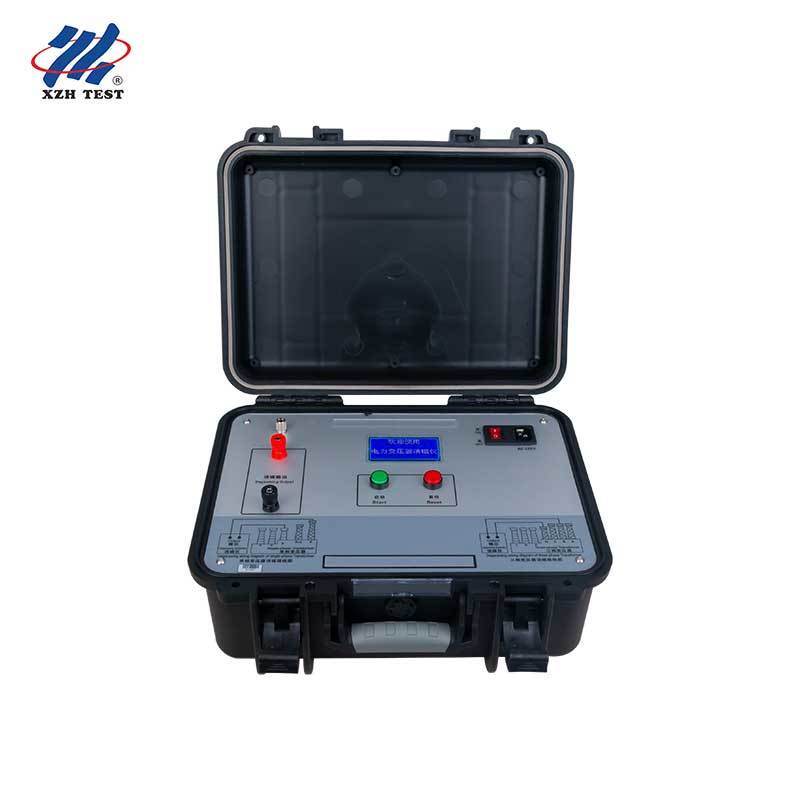
XHXC105 Portable Transformer Degaussing Instrument
The XHXC105 Transformer Degaussing Instrument is a specialized device designed to eliminate residual magnetism hazards that remain in transformer cores after DC resistance testing, voltage ratio measurements, and other diagnostic procedures. It plays a critical role in protecting power transformers from excitation inrush current impact and ensuring safe, reliable commissioning of transformers at 35kV and above — particularly large-capacity units at 330kV+ voltage levels.
Built on patented DC frequency conversion attenuation technology, the XHXC105 introduces an automatic degaussing mode alongside manual operation, eliminating repetitive user intervention. The enlarged LCD module displays richer operational information including real-time degaussing current, mode status, and progress percentage. A refined two-button interface — red for selection and reset, green for confirmation and start — simplifies field operation. Degaussing cycle time has been reduced from 30 minutes to under 4 minutes, with single-pass effectiveness exceeding 90%.

Key Features
Patented DC Frequency Conversion Attenuation: Proprietary technology progressively reduces current amplitude while alternating polarity, gradually shrinking the hysteresis loop and neutralizing residual magnetic poles for thorough demagnetization.
B-Phase Only Three-Phase Degaussing: A single connection to the B-phase bushing achieves complete demagnetization of all three phases — dramatically reducing on-site setup time and eliminating the need for multiple reconnections during transformer commissioning.
Dual-Mode Operation: Automatic mode sequentially applies 5A, 1A, 200mA, and 5mA current levels with zero user intervention. Manual mode provides individual current-level selection for targeted degaussing based on residual magnetism severity.
16-Bit AD Data Acquisition: High-resolution analog-to-digital conversion with automatic current stabilization judgment ensures precise degaussing current control and repeatable results across varying field conditions.
Sub-4-Minute Cycle Time: Single-pass degaussing completes in under 4 minutes (manual) or 9 minutes (automatic full-cycle) — a dramatic improvement from the 30-minute cycles of previous-generation instruments, enabling efficient multi-transformer commissioning schedules.
DC Resistance Test Cable Compatibility: Directly reuses the current leads from DC winding resistance testing, streamlining the transition from diagnostic testing to degaussing without cable changes.
Compact Field Design: Weighing only 5 kg (excluding test leads), the XHXC105 is purpose-built for mobile deployment across substation sites with minimal setup effort.
Technical Specifications
| Degaussing Current |
5A, 1A, 200mA, 5mA (Customizable) |
| Degaussing Mode |
Manual / Automatic |
| Degaussing Time |
Manual: 3 min/cycle | Automatic: 9 min/cycle |
| Degaussing Effectiveness |
>90% per single pass |
| Degaussing Progress |
0–100% real-time display |
| Working Power Supply |
AC 220V±10%, 50Hz±1Hz |
| Fuse Rating |
8A (AC 220V) |
| Ambient Temperature |
-25℃~50℃ |
| Ambient Humidity |
≤90% |
| Weight |
5 kg (Excluding Test Leads) |
| Display |
LCD with Real-Time Current, Mode, and Progress |
| Applicable Transformers |
35kV and Above; Optimized for 330kV+ Large-Capacity Units |
Operating Principle
The instrument employs DC frequency conversion attenuation: (1) DC degaussing current is applied; (2) Current amplitude decreases periodically; (3) Current polarity alternates periodically; (4) The hysteresis loop is progressively narrowed and magnetic poles are mutually canceled to achieve complete demagnetization.
Connection Guide
| Single-Phase Transformer |
Connect to A and X terminals |
| Three-Phase Transformer |
Connect to B-phase bushing and neutral (O) only — all three phases are degaussed simultaneously |
| Degaussing Output |
Non-polarized; output terminals have no positive/negative distinction |
Important Safety Notes
Read the user manual thoroughly and verify correct wiring before operation.
Ensure the ground terminal is reliably connected before powering on.
Do not remove test clamps during the degaussing process.
In any abnormal situation, press the red RESET button or turn off the power switch immediately.
This is a precision high-voltage electronic instrument — non-professionals must not disassemble; handle with care during transport.
Frequently Asked Questions
Q1: Why is degaussing essential before re-energizing a transformer after DC testing?
DC resistance testing inherently leaves residual magnetism in the transformer core. Without degaussing, when the transformer is re-energized, this residual flux saturates the core for half a cycle, generating massive excitation inrush currents containing high harmonic content. This can cause: protection relay maloperation leading to failed commissioning; sympathetic inrush in adjacent transformers causing cascading trips across multiple substations; physical damage to transformer windings and circuit breakers from excessive electromagnetic forces; and grid voltage instability affecting downstream equipment. The XHXC105 eliminates this risk by systematically removing residual magnetism before re-energization.
Q2: How does B-phase-only degaussing work for three-phase transformers?
The XHXC105's patented DC frequency conversion attenuation technology enables complete three-phase demagnetization through a single connection to the B-phase bushing and neutral (O). The magnetic circuit coupling within the transformer core propagates the degaussing effect across all three phases simultaneously, eliminating the need for individual A, B, and C phase connections. This reduces field setup time by approximately 70% and minimizes the risk of wiring errors during multi-transformer commissioning campaigns.
Q3: When should I use automatic mode versus manual mode?
Automatic mode is recommended for standard post-DC-test degaussing where the residual magnetism level is unknown. It sequentially applies 5A → 1A → 200mA → 5mA current levels over approximately 9 minutes, achieving >90% demagnetization without user intervention. Manual mode is suitable when you know the specific current level needed — for instance, after a partial degaussing cycle or when targeting transformers with known low residual magnetism. Manual mode completes in approximately 3 minutes per selected current level and allows targeted re-application at higher levels if needed.
Q4: What are the power supply requirements and what if the instrument fails to power on?
The XHXC105 requires AC 220V±10%, 50Hz±1Hz. The 8A fuse in the rear panel socket provides primary overcurrent protection. If the instrument fails to power on: (a) check whether the 8A fuse has blown; (b) verify the supply voltage is within 220V±10%. If using a generator, confirm the output waveform is a 50Hz sine wave and that one phase is grounded as neutral — this is the most common field power issue. An isolation transformer can also be connected in series to resolve generator waveform compatibility problems.
Q5: How does this instrument integrate with existing DC resistance testing workflows?
The XHXC105 is designed to seamlessly follow DC winding resistance testing. The same current leads used for DC resistance measurement can be directly connected to the degaussing output terminals without cable changes, eliminating the need to climb the transformer to reconnect test leads. After completing DC resistance tests on all windings, simply transfer the test lead connectors from the resistance tester to the XHXC105, select the appropriate degaussing mode, and start the cycle. The entire workflow — from final resistance measurement to completed degaussing — typically takes under 15 minutes per transformer for a standard three-winding unit.


 Your message must be between 20-3,000 characters!
 english
 français
 Deutsch
 Italiano
 Русский
 Español
 português
 Nederlandse
 ελληνικά
 日本語
日本語
 한국
한국
 العربية
 हिन्दी
 Türkçe
 indonesia
 tiếng Việt
 ไทย
ไทย
 বাংলা
বাংলা
 فارسی
فارسی
 polski