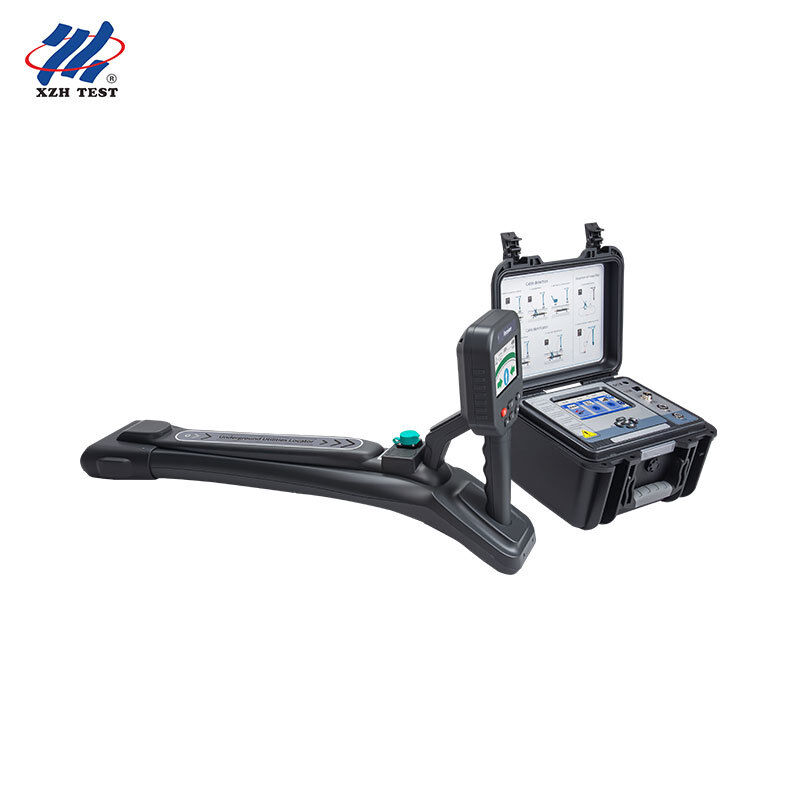
The XHGX507C1 underground cable and pipe locator is a complete utility survey system for municipal and construction sites. It traces buried power cables, telecommunication cables, metal water pipes, gas pipes and conduits, displays their route and provides direction guidance, measures burial depth and current in real time (0–20 m), and identifies a single cable among up to 20 cables sharing a duct—so crews know exactly what is below before the excavator arrives.
Striking an unknown utility during excavation is one of the most expensive and dangerous accidents on a construction site. The XHGX507C1 supports a complete pre-excavation survey procedure for utility safety: passive scanning finds live lines without a transmitter, induction mode area scanning reveals unexposed metal pipes, and each marked route can be traced and depth-verified before digging. Its guided wire cruise interface lets even staff with no locator experience trace accurately.
Designed for municipal water, gas and heating network operators, telecom field crews, utility mapping contractors and civil engineering teams to locate and map underground utilities before excavation, renovation or trenchless construction, preventing cable and pipe strikes.
| Parameter | Specification |
|---|---|
| Model | XHGX507C1 |
| Function | Cable/pipe route tracing (with direction display), real-time depth and current measurement, cable identification, A-frame ground fault finding (optional) |
| Detection range | Direct connection: 0–20 km; coupling: 0–10 km; induction: suitable for cables buried below 2 m |
| Depth measurement | 0–20 m real-time display; center-axis accuracy ±5 % (0–3 m depth), −10 % (3–20 m depth) |
| Transmitter output power | 15 W max, 9 adjustable levels, fully automatic real-time impedance matching |
| Transmitter output voltage | 300 V max (direct output) |
| Output frequency | 11 active frequencies: 640 Hz, 1.28 kHz, 2.56 kHz, 3.20 kHz, 4.09 kHz, 8.19 kHz, 10.2 kHz, 32.7 kHz, 65.6 kHz, 81.9 kHz, 197 kHz; receiver adds 50 Hz / 60 Hz / 250 Hz passive frequencies |
| Output mode | Direct connection / coupling clamp / induction—automatically identified by the connected accessory |
| Cable identification | Up to 20 pre-calibrated cables (L1–L20) with flexible clamp; pass criteria: current ≥ 0.3 mA and within 75 %–135 % of the calibrated value, with matching current direction |
| Fault location (optional) | A-frame step voltage method at 640 Hz–3.20 kHz for insulation damage, low-voltage cable ground faults and high-voltage cable sheath faults |
| Receiver display / battery | 4.3-inch capacitive touch LCD, sunlight-readable; 8.4 V 5200 mAh rechargeable lithium battery |
| Transmitter display / battery | 5-inch capacitive touch LCD; 11.1 V rechargeable lithium iron phosphate battery |
| Clamps | Transmitter coupling clamp inner diameter Φ125 mm; flexible identification clamp inner diameter Φ200 mm (larger sizes customizable) |
| Charging | Transmitter full charge (power off) about 5–6 hours; receiver about 3–4 hours; 300–500 charge cycles |
| Operating environment | Operating: -10 °C to +40 °C, RH below 80 %; storage: -10 °C to +50 °C, RH ≤ 95 % (non-condensing) |
| Safety / EMC | IEC61010-1 (CAT III 600 V / CAT III 300 V), IEC61010-031, IEC61326, pollution degree 2 |
| Step | Recommended action |
|---|---|
| 1. Passive scan | Grid-scan the work area in power (50 / 60 / 250 Hz) and RF modes to detect live cables without a transmitter. |
| 2. Induction scan | Two operators keep the transmitter and receiver about 20 m apart and scan the area in parallel to find unexposed metal pipes; repeat in the opposite direction. |
| 3. Mark suspected routes | Mark each peak response on the ground with paint; recheck strong signal lines at high gain to find weaker adjacent utilities. |
| 4. Trace and measure depth | Trace each marked route with the receiver and record depth (0–20 m) and current; verify critical depths with the 45° valley or 80 % broad-peak method. |
| 5. Identify target cable | When several cables share a duct or trench, use the flexible clamp to confirm the exact target among up to 20 calibrated cables. |
| 6. Cross-check | Because every method has limitations, repeat the survey with a different method or frequency before excavation to minimize the risk of missing utilities. |
Overall Rating
Rating Snapshot
The following is the distribution of all ratingsAll Reviews