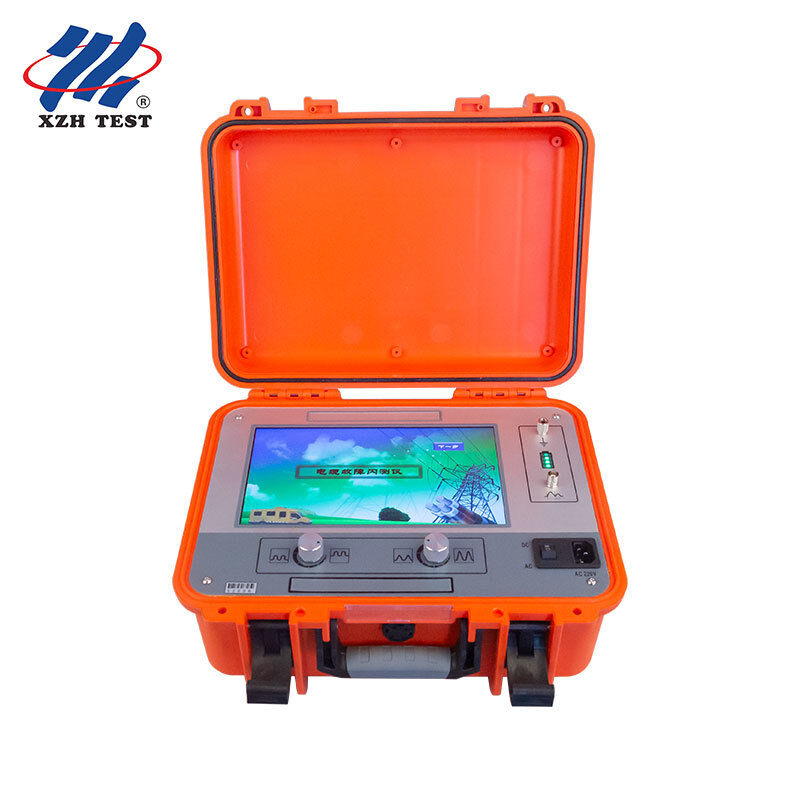
Compact, Field-Ready, One-Person Operation. The XHGG501D TDR Cable Fault Locator weighs under 5kg, boots in seconds, and runs on its built-in lithium battery — no generator, no assistant, no setup delay. From the back of a service van to a live trace in under 2 minutes.
The XHGG501D is a portable TDR-based cable fault pre-locator designed for rapid on-site diagnostics. With a 10-inch touch LCD, 100MHz real-time sampling, and MCU single-chip centralized control, it eliminates the complexity associated with laboratory-grade instruments. Operators connect the test leads, select the range preset, and press start — the instrument automatically acquires, samples, and processes the waveform to determine fault distance. Supporting both low-voltage pulse and flashover sampling methods, the XHGG501D covers low-resistance faults, open circuits, short circuits, leakage high-resistance faults, and flashover high-resistance faults across power cables, control cables, communication cables, and street light wiring. Built into an IP54 protective chassis and powered by a field-swappable lithium battery, it is the instrument of choice for utility maintenance crews, electrical contractors, and field service engineers who need reliable results without the learning curve.

From Van to Trace — Under 2 Minutes
Most cable fault locators assume a controlled environment: stable power, a workbench, and a trained operator with time to configure. The XHGG501D assumes the opposite — a rain-soaked trench at 5:30 PM, fading daylight, and a crew waiting for clearance. Here is what a typical deployment looks like:
⏱
0:00
Remove from vehicle. No warm-up cycle, no calibration procedure.
🔌
0:30
Connect test leads. Single-Q and dual-Q cables plug directly — no adapter box required.
📱
0:45
Power on. Built-in lithium battery — no generator, no extension cord. Touch screen ready.
📊
1:15
Select range preset. 300m, 1km, 3km, or 16km. One tap.
✅
1:45
Fault distance displayed. Auto-analysis marks waveform inflection point. Distance to fault in meters.
No laptop. No external software. No specialist training. The instrument does the heavy lifting — the operator reads the distance and directs the digging crew.
What the 10-Inch Touch Display Means in the Field
Many "portable" cable fault testers ship with a 4.3-inch or 5-inch resistive screen that requires a stylus and assumes indoor lighting. The XHGG501D uses a full 10-inch TFT LCD — the same class of display found on tablet computers — with touch operation that works with gloved hands. This is not just about aesthetics:
Full-Waveform Visibility: On a 5-inch screen, a long-range waveform is compressed to the point where the fault reflection spike is a few pixels wide. On the 10-inch display with 100MHz sampling data, operators can visually identify the fault inflection point without relying solely on the auto-analysis algorithm. When the algorithm flags a borderline reflection — common on aged cables with multiple joints — the operator can visually confirm or override the automated reading.
Dual-Mode Control: Touch screen for rapid navigation through menus and presets; physical coded buttons for precise cursor positioning when measuring the fault waveform. Two operators can work simultaneously — one navigating, one measuring — on complex multi-fault traces.
Sunlight-Readable with Anti-Glare: Industrial-grade LCD with LED backlight maintains visibility at 280nit brightness. Operable in direct sunlight at outdoor substations and roadside cabinets without a shade cover.
100MHz Sampling — Real-Time, Not Interpolated
The XHGG501D samples at a true 100MHz — 100 million data points per second — without software interpolation. This matters at short range: when testing a 300m cable with a 0.1μs narrow pulse, the instrument achieves 0.5m minimum resolution, sufficient to distinguish a fault at a cable joint from a fault inside the joint itself. The auto-ranging system continuously adjusts gain and sampling depth, capturing the reflection pulse regardless of whether it arrives at 0.2μs (near-end fault) or 80μs (far-end fault). Combined with a ≤20m blind zone — one of the best in its class — the XHGG501D reliably detects faults from the output terminals outward.
Key Specifications
| Parameter |
Value |
Notes |
| Sampling Frequency |
100MHz |
Real-time hardware sampling, no interpolation |
| Minimum Resolution |
0.5m |
At 0.1μs pulse on 300m range |
| Test Range |
≤16km |
Presets: 300m / 1km / 3km / 16km |
| Test Blind Zone |
≤20m |
Reliable detection from output terminals |
| Measurement Error |
≤±(0.5%*L+1m) |
L = cable length under test |
| Pulse Width |
0.1μs / 2μs |
Narrow pulse for near-end, wide pulse for far-end |
| Test Methods |
LV pulse + flashover |
Dual-mode covers full fault spectrum |
| Display |
10-inch TFT LCD |
Touch + coded button dual operation |
| Platform |
MCU centralized control |
Single-chip architecture for reliability |
| Battery |
Built-in lithium-ion |
Cordless operation, field-swappable |
| Power Input |
AC 220V±10% |
Mains charging and direct operation |
| Protection |
IP54 |
Dust-protected, splash-proof chassis |
| Operating Temperature |
-20℃~+60℃ |
Full outdoor temperature envelope |
| Relative Humidity |
<90% |
Non-condensing |
| Compliance |
CE, ISO |
|
Package Contents
| Item |
Qty |
Item |
Qty |
| Cable Fault Locator (Host) |
1 |
Single-Q Cable (1.5m) |
1 |
| Dual-Q Cable (2m) |
1 |
Sampler |
1 |
| Power Cord (1.8m) |
1 |
Safety Fuse Tube |
1 |
| Ground Wire |
1 (optional) |
User Manual |
1 |
|
Instrument Composition List
|
|
name
|
quantity
|
picture
|
name
|
quantity
|
picture
|
|
Cable fault pre-locator
|
1
|
|
Single Q line
|
1
|
|
|
Double Q line
|
1
|
|
sampler
|
1
|
|
|
power cable
|
1
|
|
Fuse
|
1
|
|
|
Ground wire
(optional)
|
1
|
|
|
|
|
XHGG501D at a Glance — Two Sides of the Same Tool
|
This Listing — Portable Field Angle |
Alt Listing — Entry System Angle |
| Core Focus |
Rapid one-person deployment, van-to-trace under 2 minutes |
First-time cable fault testing investment, total cost of ownership |
| Visual Theme |
Amber orange — field readiness, visibility |
Green — accessibility, low entry barrier |
| Best For |
Utility maintenance crews, field service contractors |
Small utilities, electrical contractors expanding service offerings |
| Content Emphasis |
Deployment speed, 10-inch display field benefits, 100MHz real-time sampling |
Product line comparison, cost-per-test analysis, upgrade path |
Request a quotation — or ask about a demo unit for your field crew evaluation.


 Your message must be between 20-3,000 characters!
 english
 français
 Deutsch
 Italiano
 Русский
 Español
 português
 Nederlandse
 ελληνικά
 日本語
日本語
 한국
한국
 العربية
 हिन्दी
 Türkçe
 indonesia
 tiếng Việt
 ไทย
ไทย
 বাংলা
বাংলা
 فارسی
فارسی
 polski
Overall Rating
Rating Snapshot
The following is the distribution of all ratingsAll Reviews