logo
Home > Products >
AC DC Hipot Tester
>
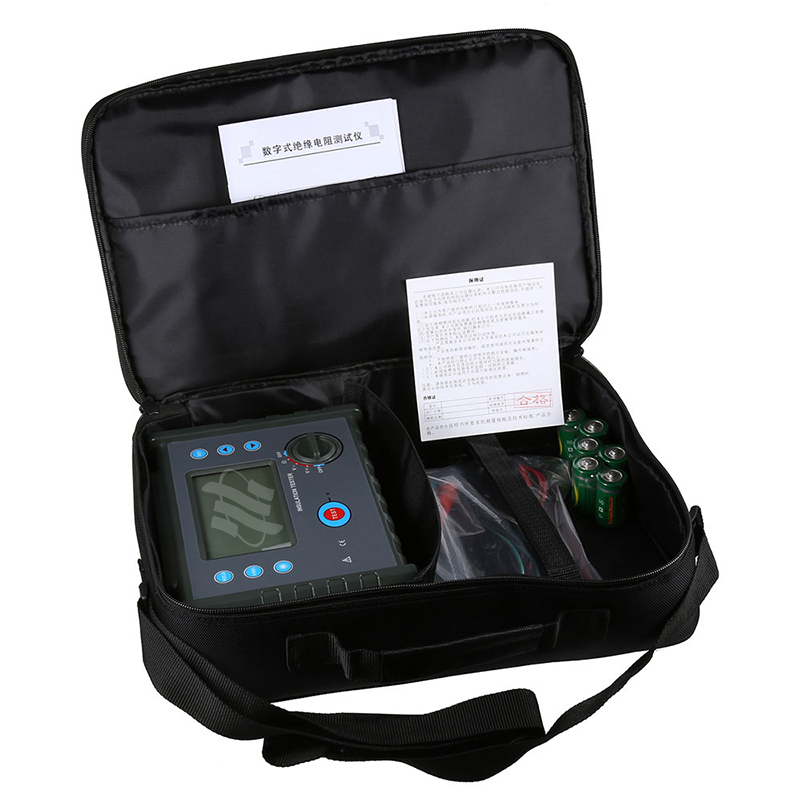
Portable Digital Insulation Resistance Tester for Cable Motor Insulation Testing

Portable Digital Insulation Resistance Tester for Cable Motor Insulation Testing

Product Details:
Place of Origin: Xi'an, Shaanxi, China
Brand Name: XZH TEST
Certification: ISO,CE
Model Number: XHMR-2500
Detail Information
Place of Origin:
Xi'an, Shaanxi, China
Brand Name:
XZH TEST
Certification:
ISO,CE
Model Number:
XHMR-2500
LCD Display Size:
108mm × 65mm
Instrument Dimensions (L×W×H):
240mm × 188mm × 85mm
USB Interface:
Equipped With A USB Interface; Supports Software Monitoring, Data Upload To A PC, Data Storage, And Printing
Communication Cable:
1 × USB Communication Cable
Test Leads:
Red High-voltage Probe (3m), Black High-voltage Test Lead (1.5m), Green Lead (1.5m)
Data Storage:
500 Sets; A Flashing "FULL" Symbol Indicates That Storage Capacity Is Full
Data Recall:
Data Recall Function; Indicated By The "MR" Symbol
Highlight:

High Light

Highlight:

Portable digital insulation resistance tester

,

Cable motor insulation tester

,

AC DC hipot tester with warranty

Trading Information
Minimum Order Quantity:
1 unit
Price:
Negotiable
Packaging Details:
wooden packaging
Delivery Time:
8-10 days
Payment Terms:
T/T
Supply Ability:
2000units/year
Product Description
1. Introduction

The insulation resistance tester—also known as a megohmmeter, high-voltage insulation resistance tester, etc.—is used for measuring insulation resistance.

2. Voltage Ranges and Accuracy
Measurement Function Measurement Range Accuracy Resolution
DC Voltage DC 0.0V – 1000V ±1.5% rdg ±3 dgt 0.1V
AC Voltage AC 0.0V – 750V ±1.5% rdg ±3 dgt 0.1V
3. Technical Specifications
Functions Insulation Resistance Test, Voltage Test, DC Current Test, Capacitance Test
Reference Conditions 23°C ±5°C, <75% RH
Rated Voltage 100V, 250V, 500V, 1000V, 2500V, 5000V
Insulation Resistance Range 0.01 MΩ – 10 TΩ | Resolution: 0.01 MΩ
Rated Voltage 250V, 500V, 1000V, 2500V, 5000V, 10 kV
Insulation Resistance Range 0.01 MΩ – 35 TΩ | Resolution: 0.01 MΩ
Rated Voltage 500V, 1000V, 2500V, 5000V, 10 kV, 15 kV
Insulation Resistance Range 0.01 MΩ – 50 TΩ | Resolution: 0.01 MΩ
Measurement Voltage (V) Rated Voltage × (1 ±10%)
DC Voltage Range 0 – 1000V | Resolution: 0.1V
AC Voltage Range 0 – 750V | Resolution: 0.1V
DC Current 0.1 nA – 6 mA | Resolution: 0.1 nA
Capacitance 10 nF – 50 µF | Resolution: 10 nF
Output Short-Circuit Current ≥6 mA @ 15 kV
Absorption Ratio (DAR) and Polarization Index (PI) Measurement Supported
Power Supply 12.6V Rechargeable Lithium Battery
Backlight Supported Controllable gray-white screen backlight, suitable for use in dimly lit environments.
Display Mode 4-digit extra-large LCD display with gray-white screen backlight.
4. Measurement Principle

Insulation resistance measurement employs a voltage generator to generate a voltage V, which is applied across the resistor. By measuring the current I flowing through the resistor, the ground resistance value R is calculated using the formula R = V/I.

Portable Digital Insulation Resistance Tester for Cable Motor Insulation Testing 0

Safety Precautions:
In all circumstances, special attention must be paid to safety when using this instrument.
This instrument has been designed, manufactured, and tested in accordance with the IEC 61010 safety specifications.
In all circumstances, special attention must be paid to safety when using this instrument.
During measurements, do not use high-frequency signal generators—such as mobile phones—in the vicinity of the instrument, as this may introduce measurement errors.
Pay close attention to the text and symbols displayed on the labels affixed to the instrument's casing.
Before use, verify that the instrument and its accessories are in good condition; specifically, ensure that the insulation on the instrument and test leads is intact, with no exposed conductors or broken wires, before proceeding with measurements.
During the measurement process, strictly avoid touching exposed conductors or the circuit currently being tested.
Ensure that the connection plugs of the test leads are firmly inserted into the corresponding ports on the instrument.
Do not perform measurements in flammable environments, as sparks generated during operation could trigger an explosion.
If the instrument's casing or test leads become damaged—exposing internal metal components—while the unit is in use, immediately cease operation.
Do not leave or store the instrument for extended periods in environments characterized by high temperatures, high humidity, condensation, or direct sunlight.
When replacing the instrument's batteries, ensure that the test leads have been disconnected from the unit and that the instrument is powered off.
If the instrument displays the "Low Battery Voltage" symbol, recharge the unit immediately; failure to do so may result in measurement inaccuracies.
Strictly avoid performing charging or data transmission operations while a measurement is in progress.