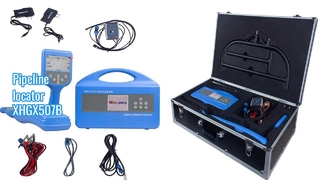
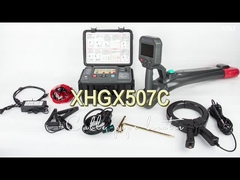
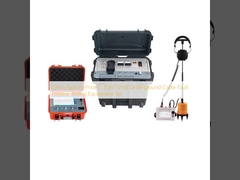
Brief: In this walkthrough, we highlight key design ideas and how they translate to performance. Watch as we demonstrate the XHHD530M Low Voltage TDR Cable Tester locating underground cable faults, measuring depth and position, and testing for shorts, breaks, and ground leaks across various challenging environments.
Related Product Features:
Transmitter with three output ranges (high, medium, low) for versatile fault detection.
Capable of checking line continuity, breaks, and mixed faults while measuring ground leakage resistance.
Receiver with high and low gear switching for clear signal detection and direction indication.
Detects faults in buried cables up to 3km long and 2m deep with high accuracy.
Operates effectively under high-voltage interference, even near 220 kV power lines.
Waterproof design allows detection of cables in paddy fields, concrete, and building walls.
Portable operation with 8.4V transmitter and 6V receiver power supplies for field use.
Measures leakage resistance to determine fault nature and provides precise location data.
Faqs:
What types of cable faults can the XHHD530M detect?
The XHHD530M can detect various underground cable faults including short circuits to ground, broken core faults, mixed faults, and measure ground leakage resistance, helping to determine the exact nature and location of the issue.
What is the maximum detection range and depth for this cable tester?
This instrument can detect cable faults up to 3km in length with burial depths of 2-3 meters, providing accurate positioning with errors less than 0.2m for ground shorts and less than 0.4m for broken core faults.
Can this tester work in challenging environmental conditions?
Yes, the XHHD530M is designed to work continuously in environments with temperatures as low as -15°C and can detect faults under various surfaces including paddy fields, cement roads, asphalt, and even near 220 kV power lines with minimal interference.