Product Overview
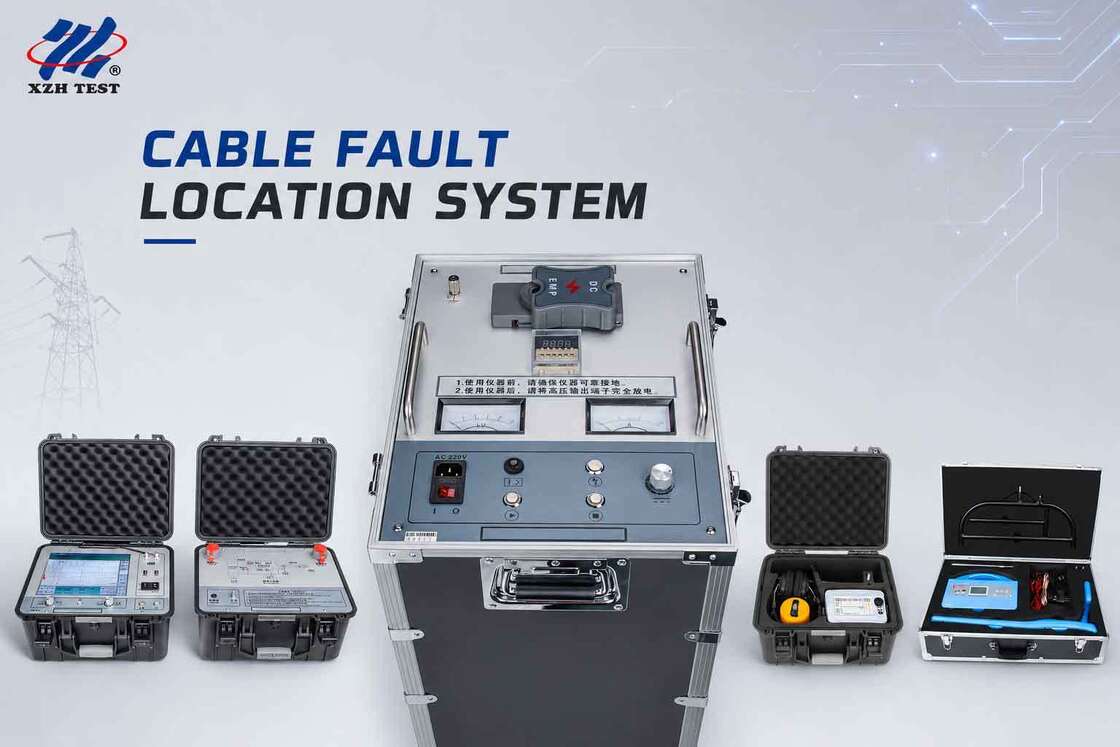
The XZH TEST Underground Cable Fault Locator System is a fully integrated, field-ready diagnostic platform for 10 kV, 11 kV, and below voltage underground power cable networks. This all-in-one solution combines a high-sampling-rate TDR pre-locator (XHGG502), a digital acoustic-magnetic pinpointer (XHDD503C), a multi-frequency cable pipe locator (XHGX507), and a portable high-voltage surge generator (XHHV535-4Z) into a coordinated platform that covers every phase of cable fault management — from insulation testing and pre-location through route tracing, precise pinpointing, and post-repair verification. Designed for utility crews, electrical contractors, and industrial maintenance teams, it delivers professional-grade accuracy and reliability in demanding field conditions ranging from -25°C to +65°C.
System Configuration
| Product Name |
Model |
Qty |
Key Capability |
| Cable Fault Pre-Locator |
XHGG502 |
1 |
TDR, HV flashover (ICE/Decay/ARC), multiple pulse ARC — 400 MHz sampling |
| Cable Pinpoint Locator |
XHDD503C |
1 |
Digital acoustic-magnetic synchronization, 0.2 m accuracy, IP65 |
| Cable Pipe Locator |
XHGX507 |
1 |
Path tracing, depth/current measurement, cable identification, step voltage |
| Portable HV Pulse Generator |
XHHV535-4Z |
1 |
0–28 kV, 1568 J discharge, ultra-lightweight design |
System Components
1. XHGG502 — Cable Fault Pre-Locator (TDR)
High-Resolution Fault Ranging & Waveform Analysis
Advanced Time Domain Reflectometer with 400 MHz sampling for rapid initial fault distance measurement. Supports multiple test methods: low-voltage pulse (TDR), high-voltage flashover (ICE, Decay, ARC single-shot), and multiple pulse ARC for difficult low-resistance and water-ingress cable faults. The 12.1-inch industrial touch-screen display provides automatic waveform capture, fault distance calculation, and massive waveform storage with USB export capability. Multiple pulse mode acquires eight waveform sets per single HV impulse, eliminating the need for delay-time adjustment and dramatically simplifying high-resistance fault analysis.
Sampling Frequency: 400 MHz
Minimum Resolution: 0.5 m (at 100 m/μs)
Ranging Range: ≥68 km
Measurement Error: ≤±(0.5%×L+1 m)
Test Methods: LV pulse, ICE, Decay, ARC single-shot, multiple pulse ARC
Pulse Coupler Withstand: DC 35 kV
Display: 12.1-inch industrial-grade touch screen
Built-in Battery: Lithium polymer, cable open/short testing without mains power
2. XHGX507 — Cable Pipe Locator (Route Tracer)
Path Tracing, Depth Measurement & Cable Identification
Multi-frequency transmitter-receiver system for underground cable route tracing, depth measurement, current measurement, and cable identification. The transmitter injects a stable sinusoidal signal into the cable under test via direct connection, coupling (clamp), or induction methods. The receiver detects and displays signal strength with bar-graph, arrow guidance, and voice prompts for intuitive one-person operation. Built-in ohmmeter measures cable loop resistance and can detect insulation faults up to 2 MΩ to ground. Supports passive 50 Hz detection and step-voltage (A-frame) method for ground-fault locating.
Working Frequencies: 815 Hz, 8 kHz, 33 kHz, 83 kHz + Passive 50 Hz
Detection Depth: Up to 10 m
Max Detection Distance: 15 km (direct connection, well-insulated cable)
Antenna Modes: Valley (zero), Crest (peak), Step voltage, Clamp current (A-frame)
Gain Control: Manual, 100 dB dynamic range
Battery: Rechargeable, continuous >8 h, intermittent >16 h
Display: Large-screen LCD with backlight, bar-graph + digital (0–999)
3. XHDD503C — Cable Fault Pinpointer
Acoustic-Magnetic Synchronization — Centimeter-Level Accuracy
Professional digital pinpointer using acoustic-magnetic synchronization for precise fault localization. When the surge generator applies HV impulses, the acoustic signal (thumping sound) and electromagnetic signal propagate from the fault point at different speeds. The pinpointer captures both signals via its ground sensor, calculates the time difference in real time, and displays four simultaneous acoustic-magnetic time-difference readings. The 5-inch sunlight-visible touch LCD provides intuitive waveform display. Features BNR background noise reduction, mute noise reduction, selectable filtering modes (all-pass, low-pass, high-pass, band-pass), and path deviation indication. IP65 waterproof with multi-layer physically isolated signal sensors.
Positioning Accuracy: <0.2 m (acoustic-magnetic)
Path Identification Accuracy: <0.5 m
Filter Parameters: All-pass (100–1600 Hz), Low-pass (100–300 Hz), High-pass (160–1600 Hz), Band-pass (200–600 Hz)
Output Gain: 16 levels (0–112 dB)
Display: 5-inch touch LCD, sunlight-visible
Battery: 4×18650 lithium, >8 h standby
Waterproof: IP65
Weight: 6.5 kg
4. XHHV535-4Z — Portable High Voltage Surge Generator
Ultra-Lightweight Impulse Energy Source
Integrated portable high-voltage pulse generator combining DC high-voltage source, energy storage capacitor, and discharge ball gap into a single unit — replacing traditional test transformers weighing hundreds of kilograms. Delivers 0–28 kV impulse with 1568 J discharge energy for fault conditioning and pinpointing on cables up to 35 kV. Also functions as a DC withstand voltage tester for electrical equipment. Features high-frequency HV technology for ultra-lightweight design (≤40 kg), zero-start safety interlock, over-temperature protection (85°C), and manual discharge button. Engineered to withstand output short-circuit without damage during field operation.
Impact Voltage: 0–28 kV
Discharge Energy: 1,568 J (4 μF built-in capacitor)
Impact Power: 400 W
Weight: ≤40 kg (ultra-lightweight portable design)
Safety: Zero-start interlock, over-temperature 85°C protection, manual discharge
Power Supply: AC 220 V ±10%, 50 Hz ±1 Hz (60 Hz customizable)
Operating Temperature: -20°C – +65°C
Complete System Specifications
| Parameter |
Specification |
| System Model |
XHGG502 + XHDD503C + XHGX507 + XHHV535-4Z |
| TDR Sampling Frequency |
400 MHz |
| Pre-Location Range |
≥68 km |
| Pre-Location Resolution |
0.5 m (at 100 m/μs) |
| Pinpointing Accuracy |
<0.2 m |
| Path Detection Depth |
Up to 10 m |
| Surge Voltage |
0–28 kV |
| Discharge Energy |
1,568 J |
| Target Cable Voltage |
10 kV, 11 kV and below (up to 35 kV for impulse testing) |
| Brand |
XZH TEST |
| Origin |
Xi'an, Shaanxi, China |
| Certification |
ISO, CE |
Complete Fault Location Workflow
Cable Insulation TestPerform initial insulation resistance measurement to confirm fault presence and characterize fault type (high/low resistance, open/short circuit).
Fault Pre-Location (XHGG502)Connect the TDR pre-locator to measure the approximate distance to the fault. Select optimal test method (LV pulse for low-resistance faults, HV flashover or multiple pulse ARC for high-resistance/flashover faults).
Route Tracing (XHGX507)Trace the exact cable path, measure burial depth, and positively identify the target cable among multiple circuits. Mark the cable route on the ground surface.
Surge Impulse Generation (XHHV535-4Z)Apply periodic high-voltage surges to the faulty cable to create detectable acoustic and electromagnetic signals at the fault point.
Precise Pinpointing (XHDD503C)Walk the cable route with the acoustic-magnetic pinpointer. Monitor the time-difference display — the point where acoustic-magnetic time delay approaches zero is directly above the fault.
Cable Repair & Re-TestExcavate precisely at the marked point, repair the cable, and verify restoration with a final insulation test to confirm operational integrity.
Applications
Urban Distribution Networks: Fault location on buried 10 kV and 11 kV distribution cables in city environments — precise sub-0.2 m pinpointing minimizes road excavation and traffic disruption.
Industrial & Commercial Facilities: Diagnostics on plant power distribution cables, including those running under concrete floors, paved yards, and building foundations where access is constrained.
Electrical Utilities & Service Contractors: Routine preventive maintenance, emergency fault response, and post-installation commissioning testing for LV/MV cable networks.
Renewable Energy & Infrastructure: Cable fault detection in wind farms, solar plants, airports, and rail networks where rapid fault recovery is critical to operational continuity.
Packaging & Delivery
| Item |
Detail |
| Packaging |
Reinforced wooden case with internal foam cushioning |
| Shipping Time |
8 – 10 working days |
| Supply Capacity |
1,000 sets per year |
| Minimum Order Quantity |
1 unit |
| Payment Terms |
T/T |
Frequently Asked Questions
Q1: What makes the XHGG502's multiple-pulse ARC method superior for high-resistance faults?
The XHGG502 pre-locator's patented multiple-pulse ARC reflection method acquires 8 waveform sets per single HV impulse. Unlike conventional secondary-pulse methods that struggle with cosine oscillation interference on long cables or high-resistance faults, the multi-pulse approach guarantees clean, interpretable fault reflections regardless of cable length, fault distance, or oscillation period. This is particularly effective for water-ingress faults in paper-insulated cables and high-impedance sheath faults where standard TDR produces weak or ambiguous reflections.
Q2: How does the XHGX507 cable pipe locator handle congested underground environments?
The XHGX507 operates on four active frequencies (815 Hz, 8 kHz, 33 kHz, 83 kHz) plus passive 50 Hz detection, allowing the operator to select the optimal frequency for each environment. Higher frequencies (33/83 kHz) provide strong signal coupling for shallow cables in congested ducts; lower frequencies (815 Hz/8 kHz) travel further and couple less to adjacent utilities, providing cleaner identification on deep or long cable runs. The four antenna modes (valley, crest, step voltage, clamp current) plus 100 dB manual gain control give operators the flexibility to isolate the target signal in the most complex underground infrastructure.
Q3: Can this system operate reliably in extreme field conditions?
Yes. Every component is engineered for harsh environments: the XHGG502 with a 12.1-inch industrial touch screen operates from -25°C to +65°C; the XHDD503C pinpointer is IP65 waterproof with multi-layer physically isolated sensors; the XHGX507 receiver includes a sunlight-visible LCD with backlight; and the XHHV535-4Z surge generator features over-temperature protection (85°C cutoff), automatic post-operation discharge, and zero-start safety interlock. The complete system can be deployed in rain, dust, heat, and cold with no degradation in measurement accuracy.
Q4: What accessories and consumables are included with the system?
Each system ships complete with: high-voltage output cable (10 m, 50 kV DC rated, shielded), grounding cable set (3-column, 10 m), coupling clamp (Φ150 mm), A-frame for step-voltage detection, chargers for all battery-powered components, spare 18650 lithium cells for the pinpointer, and comprehensive English-language user manuals. All accessories are individually packed in reinforced wooden cases alongside the main instruments for organized, damage-free international shipping.
Q5: What are the purchasing terms, warranty, and delivery schedule?
Standard Shipping Time time is 8–10 working days after order confirmation. Each system component is packed in individual reinforced export-grade wooden cases with internal foam cushioning. XZH TEST provides standard manufacturer warranty with optional extended coverage. Minimum order quantity is 1 unit, with T/T payment terms. Annual supply capacity is 1,000 sets, ensuring availability for both individual evaluation purchases and large-scale utility deployment programs.


 Your message must be between 20-3,000 characters!
 english
 français
 Deutsch
 Italiano
 Русский
 Español
 português
 Nederlandse
 ελληνικά
 日本語
日本語
 한국
한국
 العربية
 हिन्दी
 Türkçe
 indonesia
 tiếng Việt
 ไทย
ไทย
 বাংলা
বাংলা
 فارسی
فارسی
 polski

Overall Rating
Rating Snapshot
The following is the distribution of all ratingsAll Reviews