Adjustable High Voltage Pulse Generator 0-12kV HV Surge Device
Low Voltage Surge Generator
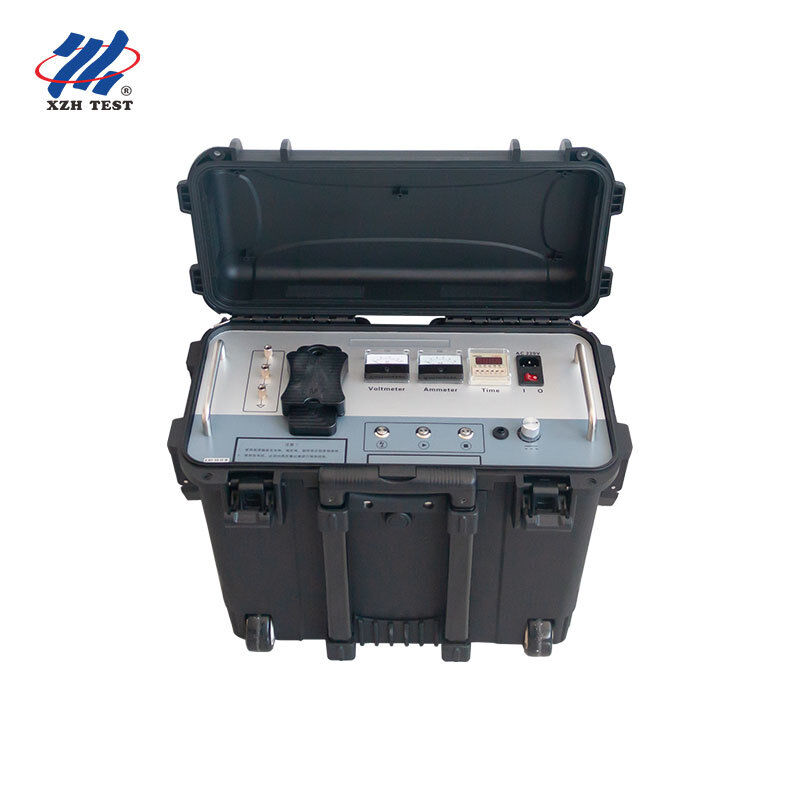
The XHHV512-12L low voltage pulse generator is a tie-rod portable integrated device, which is mainly used for shock discharge during low-voltage cable fault testing. The pulse generator adopts humanized design operation mode, high-precision dedicated high-voltage electronic components and high-frequency high-voltage technology, which is easy to operate, light in weight and easy to carry.
Panel Function Description
- Safety ground: The ground of the instrument shell must be reliably connected to the ground to prevent the instrument shell from being electrified .
- High-voltage ground: Also known as high-voltage tail, must be grounded reliably to prevent high-voltage leakage and discharge.
- Sampling ground: The negative terminal of the pulse energy storage capacitor has a high voltage and must be grounded reliably.
- Discharge button: Press to make contact with the ball gap for manual discharge (duration of each press cannot exceed 1s).
- High voltage start button: Press to start the device and generate high voltage output when the button light is on.
- High-voltage stop button: Press to cut off the high-voltage output when test is completed or an abnormality occurs.
- Over-current protection switch: Pressed position indicates over-current protection is active.
- Voltage adjustment: Turn knob clockwise to increase output voltage, counterclockwise to decrease.
- Power switch: "I gear" turns on AC 220V power, "0 gear" turns off system power.
- Fuse holder: Contains the fuse for the AC 220V power supply system.
- Power socket: AC 220V connection port.
- Time setting: Adjusts discharge time interval.
- Ammeter: Indicates current on the high voltage side.
- Voltmeter: High voltage output voltage indicating kV meter.
- High-voltage output (EMP): Connection point for high-voltage output line during impact discharge.
- High voltage output (DC): Connection point for high voltage output line during DC withstand voltage.
Technical Specifications
| Parameter |
Value |
| Impact high voltage |
0~12kV |
| High voltage partial pressure |
2.5 level |
| Built-in capacitor |
12μF |
| Output voltage polarity |
Negative polarity |
| Impact power |
250W@peak |
| Working mode |
Selectable or adjustable impulse rate and Single shot |
| Length of test cable |
High-voltage output line: 2m, Ground line: 3m, Power line: 1.8m |
| Minimum Output current in DC mode |
30mA at 12kV |
| Over temperature protection |
65ºC |
| Over current protection |
8mA (more than 3 seconds) |
| Power supply |
AC220V±15%, 50Hz±2Hz(60Hz) |
| Ambient temperature |
-20~+60ºC |
Packing List

▎Frequently Asked Questions
Q: How does a high voltage surge generator work in cable fault detection?
The surge generator discharges a high-energy pulse into the faulty cable, creating a controlled high-voltage arc at the fault point. This arc produces both an acoustic signal (loud thumping sound detectable by ground microphones) and an electromagnetic pulse (detectable by an inductive receiver). By combining acoustic and electromagnetic signal arrival times, operators can pinpoint the exact fault location with precision—a technique known as acoustic-magnetic synchronization.
Q: Which voltage range should I select for different cable types?
Voltage selection follows the cable's rated operating voltage as a general guideline. For low-voltage cables (up to 1kV), use the 8kV or 12kV range. For medium-voltage distribution cables (6-15kV), the 16kV range is appropriate. For high-voltage transmission cables (35kV and above), use the 32kV range. Always consult the cable manufacturer's maximum test voltage specifications and ensure all safety clearances are maintained during high-voltage operation.
Q: What safety precautions must be observed during surge generator operation?
High voltage surge generator testing requires strict safety protocols. Always verify the cable is fully de-energized and isolated from all power sources before connection. Establish a minimum 5-meter safety perimeter around the test zone with warning signs. All personnel must wear appropriate PPE including arc-rated clothing, HV insulating gloves, and dielectric overshoes. The integrated safety features—automatic discharge upon power-off, emergency stop, and zero-voltage interlock—provide additional layers of protection but should never replace proper safety procedures.
Q: What is the advantage of multiple energy levels (Joules) on this unit?
Different energy levels serve different diagnostic purposes. Low energy settings (e.g., 864J–1024J) are ideal for initial fault confirmation and locating high-resistance faults where excessive energy could worsen cable damage. Medium energy (1225J–2048J) provides optimal acoustic signal strength for most routine fault pinpointing. High energy (2450J+) is reserved for very long cables, deep burial scenarios, or high-impedance faults that require stronger arc generation to produce a detectable acoustic signature. The three-level selection allows operators to match energy output to field conditions.
Q: What warranty and support is included with this surge generator?
12-month standard warranty against manufacturing defects with lifetime technical support. CE and ISO 9001:2015 certified. Each unit includes the surge generator, HV output cable, ground cable, discharge rod, user manual, and a rugged transport case. On-site installation, commissioning, and operator safety training are available upon request. Spare parts including discharge gaps, capacitors, and HV diodes are stocked for rapid replacement.


 Your message must be between 20-3,000 characters!
 english
 français
 Deutsch
 Italiano
 Русский
 Español
 português
 Nederlandse
 ελληνικά
 日本語
日本語
 한국
한국
 العربية
 हिन्दी
 Türkçe
 indonesia
 tiếng Việt
 ไทย
ไทย
 বাংলা
বাংলা
 فارسی
فارسی
 polski
Overall Rating
Rating Snapshot
The following is the distribution of all ratingsAll Reviews