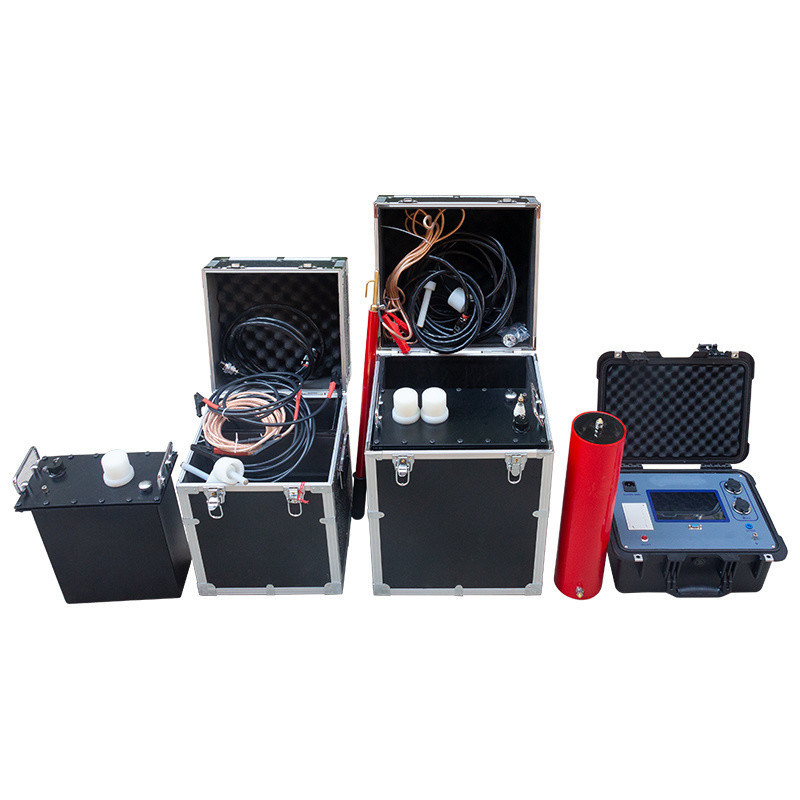
One 4 kg controller, four standard peak ratings from 30 kV to 80 kV, and a booster that changes with the voltage class. This page sets out what every model shares and what actually differs.
The XHDP series is a family of 0.1 Hz VLF AC hipot testers built around one controller platform. Four ratings are standard - 30 kV, 50 kV, 60 kV and 80 kV peak - and the same controller drives any of them. What changes with the voltage class is the booster, not the control unit, so a test department that covers more than one cable class can extend coverage without buying a second complete set.
| Model | Rated voltage | 0.1 Hz | 0.05 Hz | 0.02 Hz | Booster structure | Typical cable class |
|---|---|---|---|---|---|---|
| XHDP-30 | 30 kV peak | ≤ 1.1 µF | ≤ 2.2 µF | ≤ 5.5 µF | Single | 10 kV |
| XHDP-50 | 50 kV peak | ≤ 1.1 µF | ≤ 2.2 µF | ≤ 5.5 µF | Single | 15 kV |
| XHDP-60 | 60 kV peak | ≤ 1.1 µF | ≤ 2.2 µF | ≤ 5.5 µF | Single | 25 kV |
| XHDP-80 | 80 kV peak | ≤ 1.1 µF | ≤ 2.2 µF | ≤ 5.5 µF | Two, in series | 35 kV |
Two things move with the rating: the peak output voltage, and whether the set uses one booster or two in series. Controller, frequencies, load ladder, accuracy and protection behave identically across the series. That is the point worth understanding before comparing quotations, because a 30 kV set and an 80 kV set are the same instrument on the control side - the difference is how much voltage the high voltage side can deliver and how it is arranged to get there.
Weight of the controller and booster, supply fuse rating and protection response time are set out in the technical documentation issued with each set. We do not publish a single figure for the whole series, because those values are configuration-dependent. Ask for the figures for the model you are considering and we will confirm them in writing with the quotation.
The 30 kV peak model is the standard match for 10 kV class cable and motors. The 50 kV model is used for the 15 kV class, the 60 kV model for the 25 kV class and the 80 kV model for the 35 kV class. The test voltage and duration themselves follow the standard applied on site.
Yes. The same 4 kg controller runs any booster in the series. A department that starts with 10 kV cable work can add a 50 kV or 80 kV booster later instead of buying a second complete set.
No. The standard range is 30, 50, 60 and 80 kV peak. The 40 kV and 90 kV versions are built to order against a specific test list and are quoted separately.
220 V +/- 5 %, 50 Hz +/- 5 Hz. With a portable generator, the set needs more than 3 kW and a stable 220 V / 50 Hz output; a generator with a fluctuating output makes the automatic boost unstable.
Send the cable classes and the capacitance per phase in your test list, and we will confirm which booster or boosters cover it without a second set.
Overall Rating
Rating Snapshot
The following is the distribution of all ratingsAll Reviews