logo
Home > Products >
Transformer Tester
>
Transformer Winding Deformation Analyzer with Frequency Sweep| XHBX1502

Transformer Winding Deformation Analyzer with Frequency Sweep| XHBX1502

Product Details:
Place of Origin: Xi'an Shaanxi China
Brand Name: XZH TEST
Certification: ISO CE
Model Number: XHBX1502
Detail Information
Place of Origin:
Xi'an Shaanxi China
Brand Name:
XZH TEST
Certification:
ISO CE
Model Number:
XHBX1502
Highlight:

High Light

Highlight:

Segmented frequency sweep measurement Transformer Winding Deformation Analyzer

,

DDS-based digital high-speed frequency sweeping Frequency Response Analyzer

,

Wireless Bluetooth interface Transformer Tester

Trading Information
Minimum Order Quantity:
1set
Price:
Negotiable
Packaging Details:
wooden packaging
Delivery Time:
5-8 work days
Payment Terms:
T/T
Supply Ability:
3000unit/year
Product Description

XHBX1502 Transformer Winding Deformation Analyzer is an advanced non-destructive diagnostic instrument based on Frequency Response Analysis (FRA) technology, designed for detecting internal mechanical faults in power transformers rated from 63kV to 500kV. When a transformer is manufactured, each winding possesses a unique, stable frequency response signature determined by its distributed capacitance (Ci) and inductance (Li) parameters. Events such as short-circuit faults, transportation impacts, seismic activity, or electromagnetic forces from through-fault currents can physically displace or deform windings, altering these distributed parameters and producing measurable changes in the frequency response. The XHBX1502 employs DDS-based digital high-speed frequency sweeping to capture and compare these signatures, quantifying the magnitude, location, and direction of response deviations to determine whether the transformer requires major repair — all without invasive testing or oil drainage.

Technical Specifications
Parameter Specification
Measurement Performance
Amplitude Measurement Range -120 dB to +20 dB
Amplitude Measurement Accuracy 0.1 dB
Scanning Frequency Accuracy 0.005%
In-Phase Test Repeatability 99.9%
Signal Characteristics
Signal Input Impedance 1 MΩ
Signal Output Impedance 50 Ω
Signal Output Amplitude ±20 V
Application & Physical
Applicable Transformer Rating 63 kV – 500 kV
Instrument Dimensions (L×W×H) 340 × 240 × 210 mm
Case Dimensions (L×W×H) 370 × 280 × 260 mm
Cable Box Dimensions (L×W×H) 420 × 300 × 300 mm
Overall Weight 20 kg
Environmental
Operating Temperature -10℃ to +40℃
Storage Temperature -20℃ to +70℃
Relative Humidity < 90%, non-condensing
Key Performance Features
DDS-Based Digital High-Speed Frequency Sweep — Direct Digital Synthesis (DDS) technology generates precise, repeatable excitation signals across the measurement frequency range, delivering 0.005% scanning frequency accuracy and 99.9% in-phase test repeatability for highly reliable before-and-after comparisons.
Segmented Frequency Sweep Measurement — Automatically divides the frequency spectrum into optimized segments, concentrating measurement resolution in frequency bands most sensitive to specific winding deformation modes — radial buckling, axial telescoping, and hoop compression.
Wide Dynamic Range Analysis — (-120dB) to (+20dB) amplitude measurement range captures both subtle early-stage winding changes and gross deformation signatures, with 0.1dB resolution for fine discrimination between normal aging effects and fault-related structural changes.
Wireless Bluetooth Interface — Integrated Bluetooth connectivity enables wireless data transfer to PC or tablet for advanced analysis, report generation, and database management — eliminating cable clutter in the substation workspace.
Non-Destructive Testing Methodology — Frequency response analysis requires no oil drainage, no internal access, and no high-voltage excitation — making it inherently safer and faster than alternative diagnostic methods while providing equivalent or superior detection sensitivity for winding deformation.
Three-Phase Comparative Analysis — Captures and overlays frequency response signatures from all three phases simultaneously, enabling instant visual comparison of inter-phase deviations that indicate asymmetric winding deformation.
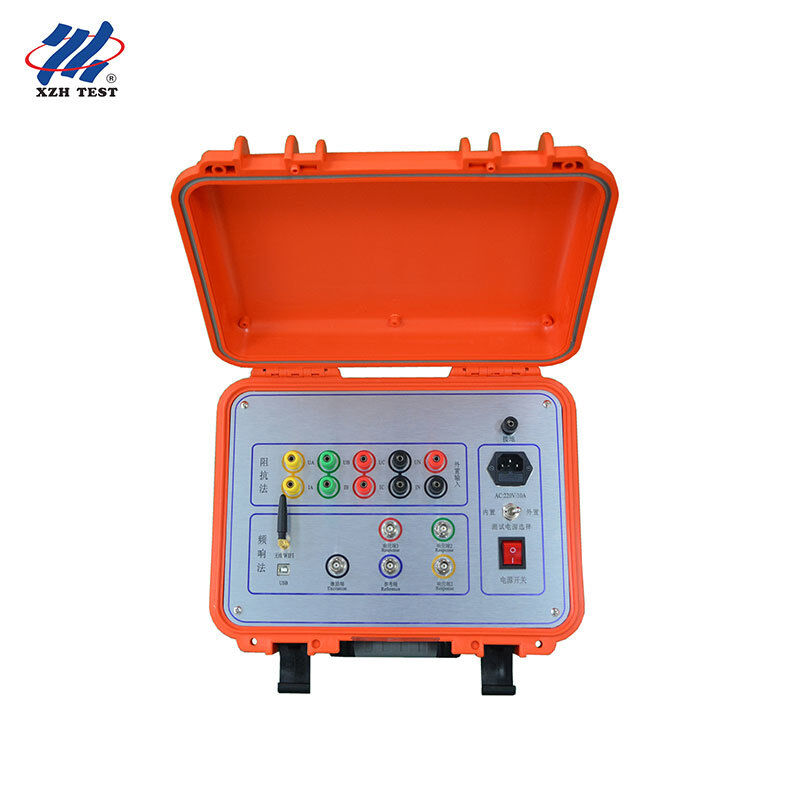
Rugged Field-Ready Packaging — Aluminum alloy instrument case and separate cable box provide robust protection during transport and storage, with a total system weight of 20 kg that balances portability with instrumentation capability for 63kV–500kV testing.
Product Image

XHBX1502

Frequently Asked Questions
Q1: Is this analyzer suitable for transformer condition monitoring and diagnostic specialists?
Yes, the XHBX1502 is an essential tool for transformer condition monitoring programs. Unlike oil testing or electrical measurements that detect secondary effects, FRA directly measures the mechanical integrity of windings — the physical structure itself. Diagnostic specialists can establish a baseline frequency response fingerprint when the transformer is known to be healthy (post-manufacturing or post-commissioning), then perform periodic retests to detect progressive deformation from accumulated fault exposure, thermal cycling, and aging. The 99.9% repeatability ensures that observed changes represent genuine structural developments rather than measurement variability.
Q2: Can high-voltage substation maintenance engineers use this for routine inspection?
Absolutely. Substation maintenance teams managing 63kV–500kV transformer fleets can integrate FRA testing into scheduled outage maintenance programs. The XHBX1502’s DDS-based automated frequency sweep and Bluetooth wireless data transfer streamline the test workflow: connect the instrument, initiate the automated sweep sequence, and review the comparative frequency response plot. The segmented sweep feature optimizes the test duration while maintaining diagnostic sensitivity, making it practical to test multiple transformers during a single scheduled outage window.
Q3: How does it serve transformer factory testing and R&D departments?
Transformer manufacturers and R&D centers use FRA for design validation, type testing, and quality assurance. The XHBX1502’s high-resolution measurement chain (0.005% frequency accuracy, 0.1dB amplitude accuracy, 99.9% repeatability) provides the precision needed for engineering analysis of winding design alternatives, investigation of manufacturing tolerances, and establishment of factory baseline signatures. The wireless Bluetooth interface enables seamless integration with engineering workstations for advanced post-processing, comparison against design simulations, and archiving of factory reference data for the transformer's entire service life.
Q4: Is it appropriate for post-fault electrical forensic investigation teams?
When a transformer experiences a major through-fault or protective relay operation, forensic investigators need to determine whether the transformer is safe to return to service or requires repair. The XHBX1502 provides the critical mechanical integrity evidence: comparison of post-fault frequency response against the pre-fault baseline (or against sister-unit baselines) reveals whether windings have moved. This objective, quantifiable data is essential for insurance claims processing, warranty dispute resolution, and regulatory incident reporting — often making the difference between a straightforward return-to-service decision and an unnecessary, costly internal inspection.
Q5: Can transportation and logistics insurance assessors use this for damage verification?
When large power transformers are transported by road, rail, or sea, the mechanical shock and vibration exposure can cause winding displacement even without visible external damage. Insurance assessors and logistics providers can use the XHBX1502 for pre-transport baseline measurement and post-delivery verification. A stable frequency response signature confirms that the transformer survived transport without internal mechanical damage, providing objective evidence for cargo insurance sign-off and protecting all parties from disputes about when and where damage occurred. The instrument’s 20 kg total system weight makes it practical for deployment at both dispatch and receiving locations.