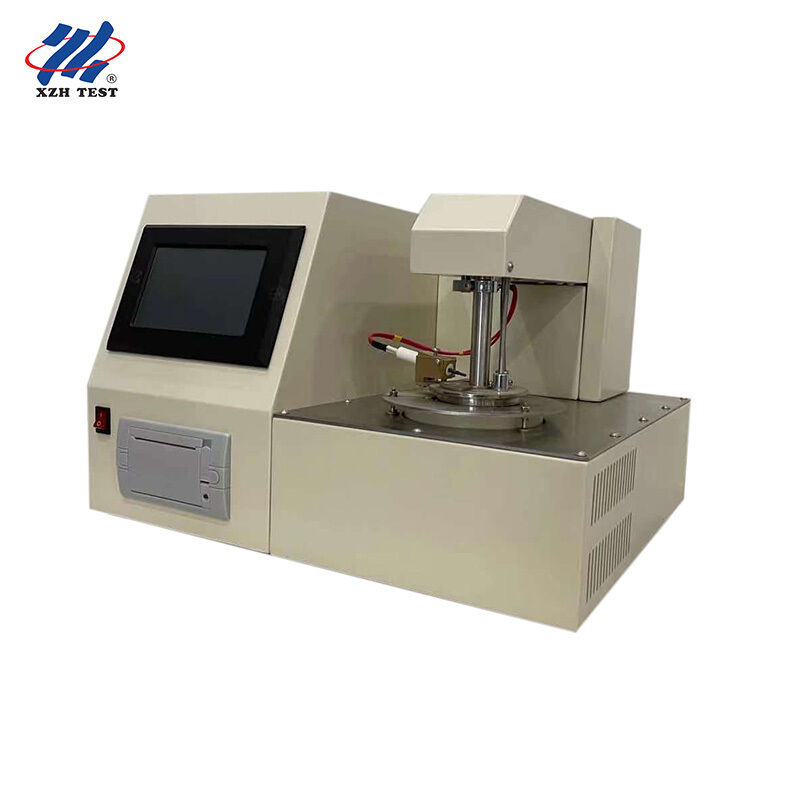
Product Overview
The XHKS183 Automatic Open Cup Flash Point Tester is a high-precision analytical instrument designed for determining the open cup flash point values of petroleum products in accordance with GB, ASTM, and EU standards. Replacing traditional mechanical keyboard operation with an advanced full-screen touch interface and a 320×240 high-resolution graphic LCD display with Chinese/English bilingual support, the instrument delivers intuitive parameter configuration and real-time test visualization. A high-speed digital signal processor (DSP) core ensures reliable data acquisition, while the built-in high-power high-frequency switching power supply with adaptive PID control algorithm automatically regulates the heating curve to meet the ramp-rate requirements of all major international flash point testing standards.
The XHKS183 uniquely supports multi-furnace operation from a single host controller, enabling parallel testing of multiple samples to dramatically improve laboratory throughput. The entire experimental process—from detection, cup opening, ignition, and alarming through to cooling and result printing—is fully automated. An integrated atmospheric pressure sensor automatically applies barometric corrections to test results, eliminating manual lookup tables and operator error. A platinum resistance temperature sensor (PT100) with 0.1℃ resolution and an ion detection ring flash fire sensor provide the precision and repeatability demanded by regulated petroleum testing environments.

Key Features
High-speed DSP core processor for reliable and accurate measurement execution
Single host controls multiple test furnaces simultaneously for parallel multi-sample testing, significantly reducing total test time
Full automation of the entire test cycle: detection, cup opening, ignition, alarm, cooling, and result printing without operator intervention
Platinum heating wire with gas ignition for stable, repeatable flash point determination
Built-in atmospheric pressure sensor with automatic barometric correction applied to all test results
High-power high-frequency switching power supply heating technology with adaptive PID control algorithm for precise heating curve regulation
Automatic over-temperature detection with immediate heating interruption and alarm activation
Thermal micro-printer delivering clear, fast output with offline printing capability
Onboard memory stores up to 255 timestamped historical test records for complete traceability
Temperature-compensated perpetual calendar clock maintaining accurate date/time recording for over 10 years during power-off conditions
320×240 large-format graphic LCD with selectable Chinese/English user interface
Full-screen touch button operation replacing mechanical keyboards for intuitive, fast parameter entry
Pre-loaded with multiple international execution standards (GB, US ASTM, EU) selectable from the touch interface
Technical Specifications
| Parameter |
Specification |
| Test Method |
Open cup flash point determination |
| Temperature Range |
Room temperature – 400℃ |
| Repeatability |
0.5% |
| Resolution |
0.1℃ |
| Accuracy |
0.5% |
| Temperature Sensor |
Platinum resistance thermometer (PT100) |
| Flash Fire Sensor |
Ion detection ring |
| Heating System |
Platinum heating wire with high-frequency switching power supply + adaptive PID control |
| Ignition Method |
Gas ignition |
| Display |
320×240 graphic LCD (Chinese/English) |
| Operation Interface |
Full-screen touch buttons |
| Atmospheric Correction |
Automatic barometric pressure detection and correction |
| Data Storage |
Up to 255 timestamped historical records |
| Printer |
Thermal micro-printer with offline printing support |
| Clock |
Temperature-compensated perpetual calendar, 10+ year battery backup |
| Heating Rate |
Compliant with GB, US ASTM, and EU standards |
| Ambient Temperature |
10–40℃ |
| Relative Humidity |
≤85% |
| Power Supply |
AC 220V ±10% |
| Power Consumption |
<500W |
| Dimensions (Host) |
190 × 260 × 285 mm |
| Dimensions (Heating Furnace) |
280 × 260 × 285 mm |
| Weight |
18 kg |
Target Audience
Unlike basic flash point testers targeting general laboratory use, the XHKS183 is engineered for high-throughput regulated testing environments where multi-standard compliance, automation, and audit-ready data management are operational necessities:
◆ Petroleum Refinery & Petrochemical Quality Control — Refinery laboratories performing routine open cup flash point testing on crude oil, fuel oil, lubricating oils, and heavy petroleum fractions for process control and product release certification. The multi-furnace capability enables simultaneous testing of multiple product batches, directly reducing QC turnaround time.
◆ Aviation Fuel & Transportation Fuel Testing — Aviation, railway, and marine fuel inspection departments where flash point is a critical safety parameter for fuel classification, storage, and transport regulations. The built-in multi-standard compliance (GB, ASTM, EU) supports cross-border fuel certification in a single instrument.
◆ Third-Party Petroleum Testing & Certification Agencies — Independent laboratories providing regulatory compliance testing for petroleum products across diverse industries. The XHKS183’s automatic atmospheric correction, 255-record audit trail with timestamps, and offline thermal printing capability meet the rigorous documentation requirements of ISO/IEC 17025 accredited laboratories.
◆ Electric Power & Industrial Transformer Maintenance — Power utility and industrial plants testing insulating oil flash point as part of transformer condition monitoring programs. The automated test cycle and DSP-based precision enable consistent, operator-independent results for trending analysis in asset management systems.
Frequently Asked Questions
Q1: What is the difference between open cup and closed cup flash point testing?
Open cup testing exposes the sample surface directly to the atmosphere, allowing lighter volatile components to escape freely. This method generally yields higher flash point values than closed cup testing, where vapors are contained. Open cup flash point (per GB/T 3536, ASTM D92, Cleveland Open Cup) is typically used for heavier petroleum products such as lubricating oils, fuel oils, and heavy hydrocarbon fractions where loss of light components is minimal under test conditions. Closed cup methods (such as the companion XHKS184 model) are preferred for lighter products like solvents, jet fuel, and kerosene where vapor containment is critical for accurate measurement. The XHKS183 is specifically configured for open cup measurement, while its companion model handles closed-cup testing.
Q2: How does the multi-furnace capability improve laboratory productivity?
Conventional single-furnace flash point testers process one sample at a time, with each complete test cycle (heating, detection, cooling) requiring 30–60 minutes depending on the expected flash point. The XHKS183’s architecture allows one host controller to manage multiple heating furnaces simultaneously. While one furnace is cooling after completing its test, another can already be heating the next sample. For laboratories running 10–20 flash point tests per day, multi-furnace operation can reduce total daily testing time by 40–60% compared with single-furnace instruments, without requiring additional bench space for multiple complete instruments.
Q3: How does the automatic atmospheric pressure correction work?
Flash point is influenced by ambient barometric pressure—at higher altitudes where atmospheric pressure is lower, the measured flash point will be systematically lower than the true value at standard pressure (101.3 kPa). The XHKS183 incorporates a built-in barometric pressure sensor that continuously monitors ambient pressure during each test. When the test completes, the onboard DSP processor automatically calculates the corrected flash point value per the pressure correction formulas specified in the selected standard (GB, ASTM, or EU). This eliminates the operator’s need to consult correction tables, manually interpolate values, or risk applying an incorrect correction factor. The raw measured value, applied correction, and final corrected result are all recorded in the test history for complete auditability.
Q4: What international standards are supported by the XHKS183?
The XHKS183 comes pre-loaded with heating rate profiles and atmospheric correction algorithms compliant with the following standards: GB/T 3536 (Chinese national standard for Cleveland open cup flash point), ASTM D92 (American standard for flash and fire points by Cleveland open cup), and relevant EU/ISO standards for open cup flash point determination. The operator selects the desired standard from the touchscreen menu before starting the test, and the instrument automatically configures the heating rate, ignition frequency, and correction formula accordingly. The instrument’s heating rate meets or exceeds the requirements of all implemented standards, ensuring compliant test results regardless of the selected method.
Q5: What maintenance and calibration procedures are required?
Routine maintenance for the XHKS183 is straightforward: (1) Clean the test cup after each use with an appropriate solvent to remove carbonized residues that can affect heat transfer and contaminate subsequent samples. (2) Periodically verify the PT100 temperature sensor accuracy using a certified reference thermometer or temperature calibrator. (3) Inspect the ion detection ring for carbon buildup and clean as needed to maintain reliable flash fire detection. (4) Verify the atmospheric pressure sensor calibration annually against a calibrated barometer. (5) For the gas ignition system, check the gas supply line connections and flame size periodically. (6) Replace the thermal printer paper roll when depleted. The instrument’s modular construction allows the heating furnace and sensor assemblies to be accessed without disassembling the main controller unit. For long-term storage, ensure the instrument is clean, dry, and disconnected from power and gas supplies.
Complete technical documentation and application support available — Contact us for on-site demonstration and method validation assistance


 Your message must be between 20-3,000 characters!
 english
 français
 Deutsch
 Italiano
 Русский
 Español
 português
 Nederlandse
 ελληνικά
 日本語
日本語
 한국
한국
 العربية
 हिन्दी
 Türkçe
 indonesia
 tiếng Việt
 ไทย
ไทย
 বাংলা
বাংলা
 فارسی
فارسی
 polski